No Password to Steal
Users on passwordless methods have no password to steal, phish, or reuse, which shuts down credential stuffing against them. On Enterprise, MojoShield Zero-Store can keep PII off MojoAuth servers entirely.
Win back the signups passwords lose, and cut password-reset support tickets by 80%.
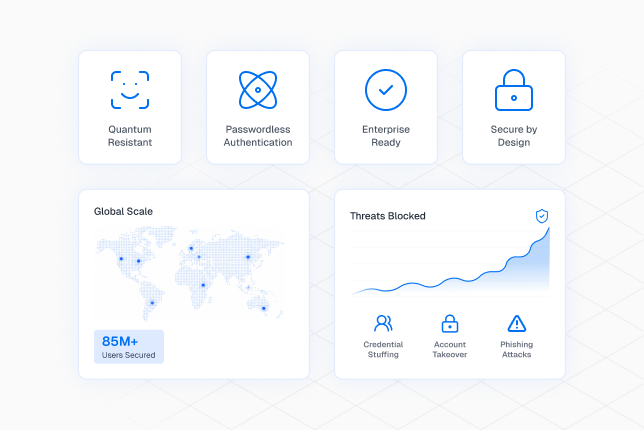
Passkeys, magic links, OTP and social login on one API - 85M+ users in our largest deployment. Enterprise adds a 99.99% uptime SLA, 24/7 support with a 1-hour critical SLA, Private Cloud and MojoShield Zero-Store. And we are preparing for post-quantum cryptography.
Sources: Verizon Data Breach Investigations Report (hacking-related breaches); IBM Cost of a Data Breach Report 2024 (average breach cost). Reset-ticket figure is MojoAuth customer data.
Of hacking-related breaches involve weak or stolen passwords (Verizon DBIR)
Average cost of a data breach in USD (IBM, 2024)
Fewer password-reset support tickets
Users in our largest deployment
Passwords lose signups at the login screen, flood support with reset tickets, and hand attackers a credential to steal
26 Billion Attacks Per Month
Notable victims: Snowflake (165+ organizations), 23andMe (6.9M users), Ticketmaster, Amtrak, Disney
$4.88M Average Breach Cost
Hidden costs: Infrastructure bills from bot traffic, strategic distraction, engineering talent attrition
80% of Hacking Breaches Involve Passwords
Reality: 15 billion stolen credentials circulating online, with no way to 'un-breach' them
1,287 Password Attacks Per Second
User reality: 25% reuse passwords across 11-20+ sites, 36% incorporate personal info
36% of Breaches Involve Phishing
Emerging threat: AI-generated deepfakes enabling synthetic identity fraud and voice phishing
$70 Per Password Reset
ROI Impact: Passwordless login cuts password-reset support tickets by 80%
GDPR Views Password Breaches as Preventable
Recent example: 23andMe fined £2.31M by UK ICO for failing to protect against credential stuffing
3 Billion Credentials Stolen in 2016 Alone
Users on passwordless methods have no password to steal. MojoShield Zero-Store (Enterprise) can also keep PII off MojoAuth servers.
RSA & ECDSA Vulnerable to Quantum Attacks
Future-proof: Post-quantum cryptography standards (ML-DSA) now available for FIDO2
Build quantum-resistant security infrastructure that protects against both current and future threats
As quantum computing advances, traditional cryptographic algorithms like RSA and ECDSA face existential threats. Current FIDO2 standards using ES256 (ECDSA with SHA-256) will become vulnerable to attacks from large-scale quantum computers.
MojoAuth is preparing for quantum-resistant authentication using Module Lattice-based Digital Signature Algorithm (ML-DSA) based on NIST-standardized Crystals-Dilithium. Our roadmap includes FIDO2-compliant, post-quantum cryptographic implementations that maintain compatibility with existing standards while protecting against quantum threats.
In April 2025, IANA officially added support for post-quantum cryptographic algorithms to the COSE codelist, signaling that the shift to quantum-safe authentication is accelerating. Organizations planning authentication strategies for the next 5+ years must consider post-quantum security today.
Passwordless methods your users already know, with passwords kept for migration while users move over
Users on passwordless methods have no password to steal, phish, or reuse, which shuts down credential stuffing against them. On Enterprise, MojoShield Zero-Store can keep PII off MojoAuth servers entirely.
One-click magic links, passkeys, and social login remove password friction. Increase conversion rates, reduce cart abandonment, and improve user satisfaction while strengthening security - not compromising it.
Cut password-reset support tickets by 80% and reduce account lockouts and other authentication support requests. Your support team spends less time on forgotten passwords.
Cloud-native architecture scales automatically from thousands to millions of users. Multi-region deployment delivers a 200ms average response time. 85M+ users in our largest deployment, a 99.99% uptime SLA on Enterprise, and zero infrastructure management.
SOC 2 Type II and ISO 27001 certified, PCI DSS and GDPR compliant, CCPA-ready, and HIPAA-ready with a BAA on Enterprise. Automatic updates keep pace with evolving regulations. Comprehensive audit logs and tamper-proof logging for forensic investigations.
RESTful APIs, SDKs in 22+ languages, and well-documented integration guides enable implementation in hours, not months. Add to existing systems without rebuilding. Run side by side while you migrate; most migrations complete in 2–3 weeks.
Passkeys, magic links, OTP, social login and One Tap on one API, with enterprise-grade security
One-click sign-in from the inbox. Good for infrequent users, and there is no password to reset.
Short-lived one-time codes sent by email or SMS. 95% of codes delivered in under 3 seconds.
One-time codes delivered in WhatsApp for markets where messaging apps dominate. Available on Enterprise.
Phishing-resistant FIDO2/WebAuthn sign-in using device biometrics or security keys.
Google, Apple and Facebook built in; GitHub, LinkedIn, Microsoft, X (Twitter), Slack, Discord and any other provider via OpenID Connect.
Users confirm sign-in with the Face ID, Touch ID or fingerprint unlock they already use. The biometric never leaves the device.
Verify phone numbers instantly through the carrier network - no OTP, no user interaction, no SIM-swap risk. Automatic OTP fallback when the carrier check is unavailable.
Context-aware multi-factor that triggers based on behavior, location, device, and risk scoring. Available on Enterprise.
TOTP support for Google Authenticator, Authy, and other time-based one-time password apps.
Advanced threat protection against credential stuffing, automated attacks, and distributed campaigns.
Secure JWT tokens, configurable session length, and instant revocation across all devices.
Branded login pages and email templates with localization support. Full white-label on Enterprise.
Available on Enterprise
Verify mobile phone numbers instantly through the carrier network - no OTP code, no user interaction, no SIM-swap vulnerability. MojoAuth Silent Auth resolves in under 5 seconds by checking the SIM identity directly with the mobile network operator.
When the carrier network is unavailable (Wi-Fi, VPN, or unsupported carrier), MojoAuth automatically falls back to SMS or email OTP within the same API call, giving you full coverage with no extra developer logic.
The carrier verifies the SIM identity directly - no code sent, no user interaction. Verification in under 5 seconds. Blocks SIM-swap and SS7 attacks at the network level.
MojoAuth detects that silent auth is unavailable and triggers SMS or email OTP automatically, within the same API call. No developer logic needed.
Multi-tenant cloud on AWS by default; Private Cloud on AWS, Azure, GCP or on-prem is Enterprise-only
Fully managed, cost-effective SaaS deployment with automatic global routing
Isolated infrastructure with custom configurations and regional compliance
Maximum control for strict data sovereignty and security requirements
Connect MojoAuth with your existing customer database, consent, privacy and security tools
SOC 2 Type II and ISO 27001 certified, PCI DSS and GDPR compliant, HIPAA-ready (BAA on Enterprise)
EU Data Protection
California Privacy
Security Standards
InfoSec Management
BAA on Enterprise
Payment Security
FIDO2/WebAuthn compliant
See how MojoAuth protects large consumer brands - up to 85M+ users in a single deployment - with passwordless authentication
Questions? Talk to sales: sales@mojoauth.com